AI Code Review Quality: What Workflow Metrics Can and Cannot Prove
An October 9 benchmark found rapid gains in AI bug detection. Learn how merged-without-review and bot-review-share metrics expose workflow risk without pretending to measure code quality.
By Ahmad Hajjar
On October 9, 2026, researchers published CRBugBench, a benchmark designed to test whether AI code review agents detect human-verified bugs. The results show rapid progress. They also show why engineering leaders should not treat review activity as proof of review quality.
The benchmark contains 1,000 tasks from 98 open-source repositories and 800 tasks from proprietary repositories at one company. Its best evaluated system caught 71.9% of bugs within its top five comments. Five months earlier, the comparable result was 47.7%.
That is a meaningful gain. It is not a reason to stop measuring how review works in production.
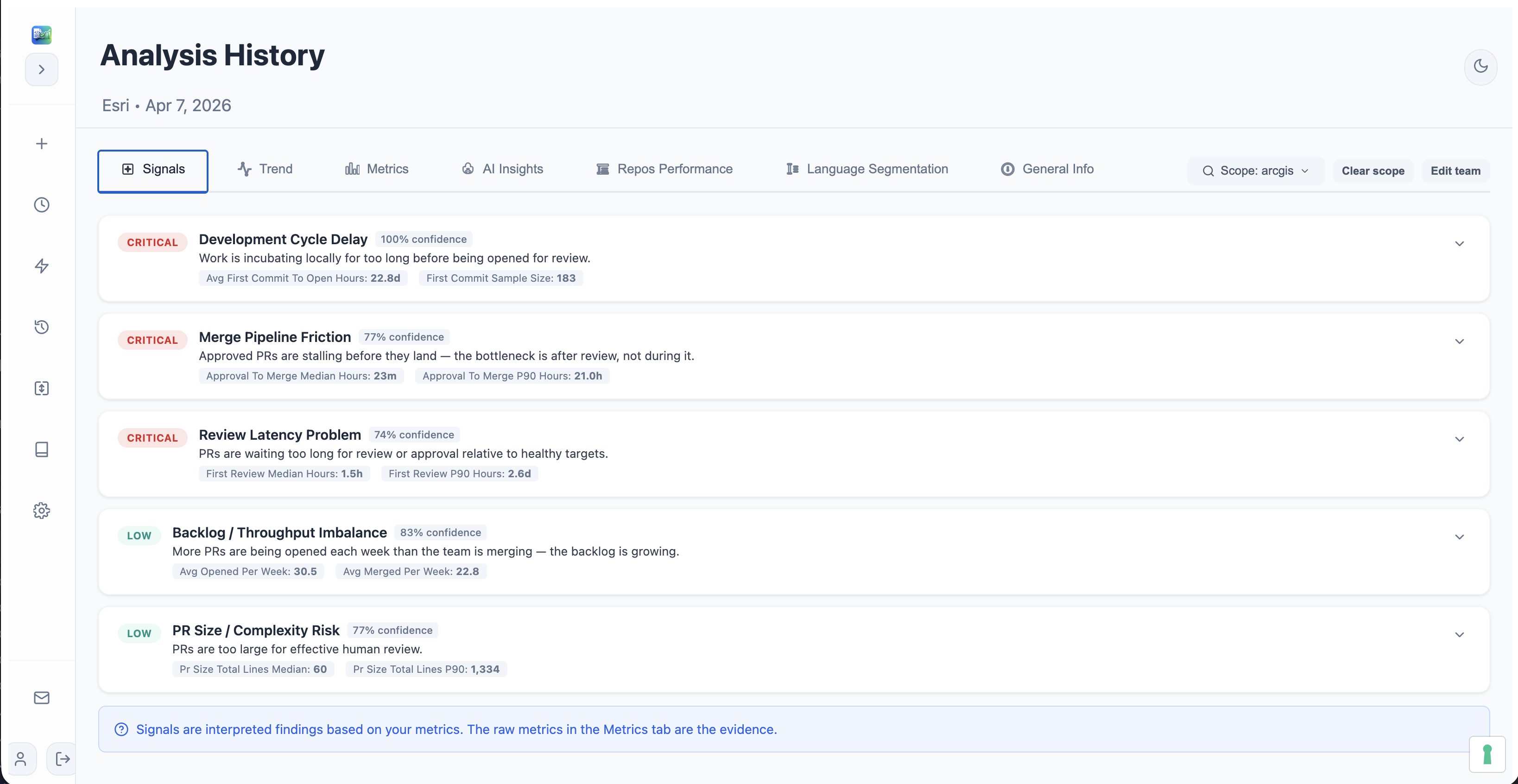
Historical GitQuick Signals screenshot from August 23, 2026. It illustrates the product surface, not the October showcase values below.
What the new benchmark measures
CRBugBench pairs a bug with the pull request that introduced it. A review agent receives the pull request and is scored on whether its comments identify the verified bug. This is much closer to the question teams actually care about than counting how many comments an agent produces.
The paper reports a clear improvement in defect detection. It also says agents remain "less effective on complex changes and bugs requiring non-local reasoning". Results dropped on proprietary repositories, where project-specific context was more important.
That distinction matters. A benchmark can evaluate whether an agent identifies known defects under controlled conditions. Your GitHub metadata can show whether a review happened, who or what submitted it, and whether a pull request merged. Neither source alone tells you whether a production review found every important problem.
GitHub's own rollout guidance makes the boundary explicit: "Using Copilot code review does not replace the need for human code review."
Three questions that teams often collapse into one
An AI code review program needs three separate scorecards.
- Model quality: Does the reviewer find relevant defects with acceptable precision and recall? Precision is the share of reported findings that are useful. Recall is the share of relevant defects the system finds.
- Workflow coverage: Which pull requests receive a recorded review before merge, and how much review activity comes from automated accounts?
- Outcomes: What happens after merge, including regressions, incidents, escaped defects, and rework?
CRBugBench addresses the first question. GitQuick addresses the second from pull request and review metadata. Most organizations need internal incident and delivery data for the third.
Treating any one of these as a substitute for the others creates a blind spot. A high benchmark score does not prove that an agent reviewed the right repositories. A high bot-review count does not prove that comments were useful. A low escaped-defect rate does not explain whether review, tests, or release controls prevented the failures.
What the Review Quality Risk signal actually detects
GitQuick's shipped Review Quality Risk signal evaluates two observable conditions:
- Merged without review: the percentage of merged pull requests with zero recorded
APPROVED,CHANGES_REQUESTED, orCOMMENTEDreview events from any account. - Bot review share: the percentage of recorded review activity attributed to bot-like accounts using login-pattern heuristics.
The default signal thresholds are above 10% for merged without review and above 50% for bot review share. Critical thresholds are 30% and 80%. These are configurable starting points, not universal quality standards. The signal becomes more severe when both conditions are elevated.
The name requires care. The signal identifies workflow risk. It does not inspect source code, validate findings, or prove that human judgment was absent from informal channels. AI reviews are a subset of bot reviews in GitQuick, not an equivalent category.
A live view of three different review patterns
GitQuick's public Showcase listed 21 organizations when this article was drafted on October 21, 2026. These three snapshots illustrate why the two workflow measures should stay separate.
| Organization | Snapshot window | Merged without review | Bot review share | Signal interpretation |
|---|---|---|---|---|
| OpenAI | Sep 15-Oct 15 | 1,689 of 3,687 (45.81%) | 2,614 of 8,672 reviews (30.14%) | Elevated bypass rate |
| GitHub | Sep 17-Oct 17 | 270 of 3,115 (8.67%) | 7,107 of 9,874 reviews (71.98%) | Elevated automation share |
| Anthropic | Sep 21-Oct 21 | 6 of 815 (0.74%) | 60 of 1,156 reviews (5.19%) | Neither default rule triggered |
OpenAI's public snapshot triggers on merged-without-review rate, not bot share. GitHub shows the reverse pattern. Anthropic is below both default thresholds. These values describe public-repository workflows during different rolling one-month windows. They do not rank code quality, product safety, or engineering culture.
The comparison also shows why one aggregate number is insufficient. A team can record extensive automation while still preserving a review event on nearly every merge. Another team can have a moderate bot share and a large class of merges with no review event at all.
What to measure after enabling AI review
Start with a small, auditable set of checks.
Separate automation participation from review coverage
Track bot and AI review share alongside merged-without-review rate. If automation rises while review coverage falls, the new reviewer is not reaching the parts of the workflow you expected.
Sample findings for usefulness
Review a fixed sample of AI comments each month. Label true issues, false positives, duplicates, style-only comments, and findings that required project context. This is the production complement to a benchmark result.
Keep a human gate where context is expensive
Use repository rules, CODEOWNERS, or branch protection for security-sensitive paths and architectural changes. The benchmark's weaker results on complex and non-local bugs make risk-based routing more useful than one policy for every pull request.
Connect workflow data to outcomes
Compare review patterns with escaped defects, rollbacks, incident involvement, and rework. Use matched repository and change-risk cohorts where possible. Do not infer causality from public metadata or an organization-level correlation.
GitQuick puts the two workflow inputs into one signal and shows the supporting evidence. That makes it easier to find a coverage gap or automation-heavy review pattern before deciding which repositories need a closer audit.
The takeaway
AI code review quality is improving quickly. CRBugBench gives teams a stronger way to evaluate defect detection. Production governance still needs a different question: did the intended review process actually happen on the changes that shipped?
For related analysis, read When AI Reviews AI and what happens after changes requested.
The dashboards below are public and require no GitHub installation:
See your review coverage and automation split →
Disclaimer: This analysis uses public GitHub metadata and the October 9, 2026 CRBugBench preprint. Showcase windows are stated in the table and were fetched on October 21, 2026. Reviewer classification is based on account login heuristics and can misclassify accounts that do not follow common naming patterns. Review counts measure activity, not review quality. Public metadata cannot prove code quality, causality, or the effectiveness of a specific review tool. GitQuick is not affiliated with or endorsed by GitHub or any organization mentioned.