Copilot Adaptive Review: Who Actually Chooses the Depth?
GitHub's Adaptive setting can select Lite, Balanced, or Max per pull request. See which setting wins, and how the maximum limits the choice.
By Ahmad Hajjar
On November 17, 2026, GitHub put Adaptive Copilot code review in public preview. Copilot can now choose Lite, Balanced, or Max for a pull request from the change's complexity and risk. An organization toggle named Adaptive is not the same thing as Copilot choosing the depth of every review.
GitHub still resolves effort through an ordered list, and a separate maximum limits how high the choice can go. Decide those two controls before you announce a new default. Secret detection, cross-repository context, and the new repository outcome reports shipped the same day. They are separate decisions.
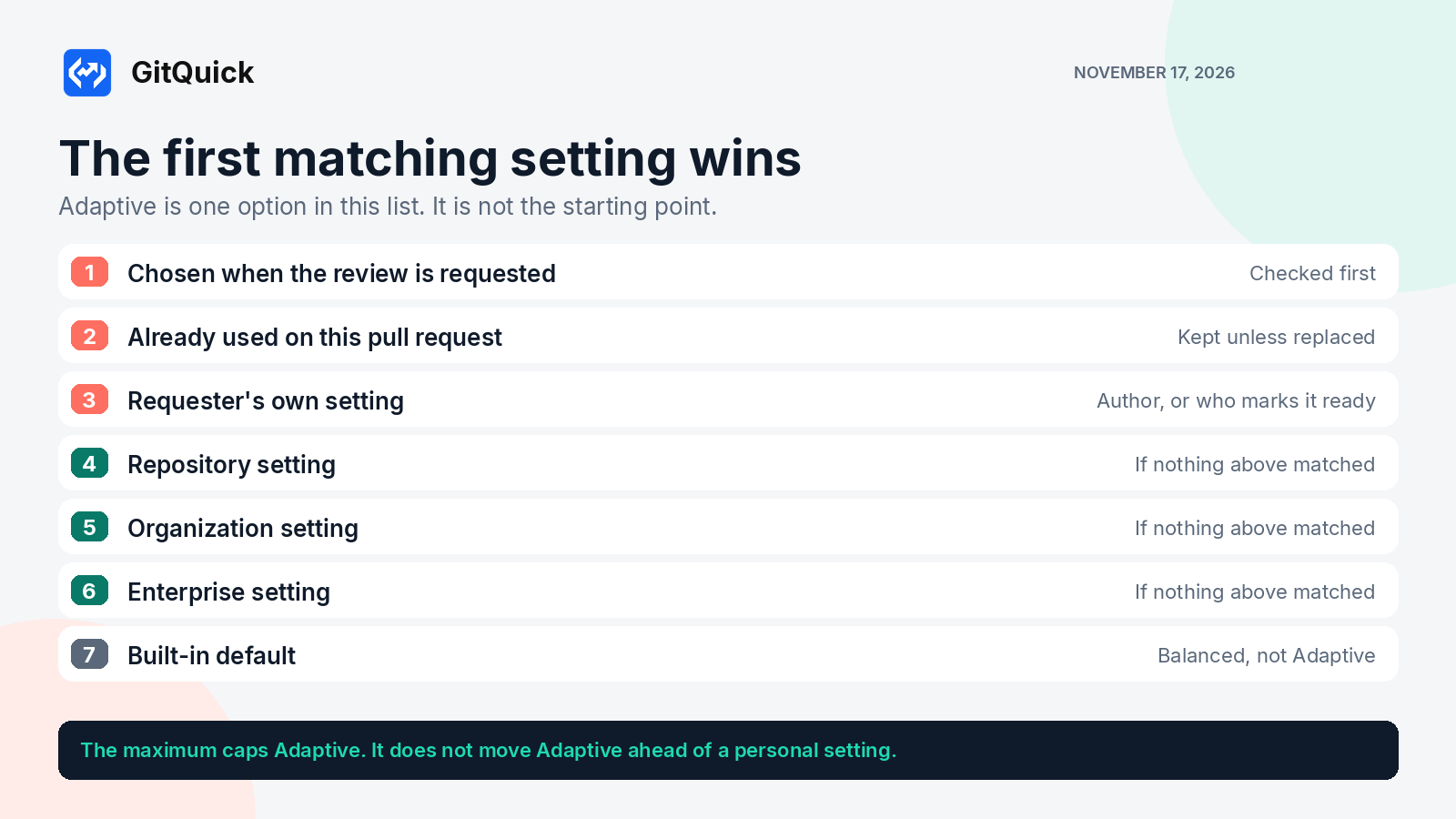
A personal setting can come first
GitHub's Copilot code review documentation says Copilot uses the first matching effort it finds:
- A level chosen when someone requests the review.
- A level already used on that pull request.
- The requester's own Copilot review effort. On a new pull request, the requester is the author. When someone marks a draft ready for review, that person is the requester.
- The repository setting.
- The organization setting, or the repository owner's setting on a user-owned repository.
- The enterprise setting.
- GitHub's built-in default, which is Balanced.
Adaptive is one value that can sit in that list. It is not the built-in default. Documentation fetched with this release says that until you pick a level, the control shows Default (Balanced).
That order decides whether an announcement matches the reviews people actually get. Authors who already chose Max or Lite on their own accounts do not pick up an organization switch to Adaptive. A pull request Copilot already reviewed can also keep its earlier level, unless someone selects a different one when requesting the next review.
The level that ran is on the pull request. After each run, the overview comment shows the effort used. That comment is the record of which setting won.
The maximum is the budget control
Lite, Balanced, and Max buy different amounts of analysis. GitHub's current documentation estimates an average of $0.25 for a Lite review, $1.50 for Balanced, and $10 for Max, with typical ranges of $0.05 to $1, $0.25 to $5, and $1.50 to $25. Consumption generally rises with pull request size and custom instructions, it can fall outside those ranges, and the estimates exclude GitHub Actions minutes. Max and Adaptive are both in public preview.
One hundred reviews at the Balanced average come to $150. One hundred at the Max average come to $1,000. That is an illustration of the published averages, not a forecast of the mix Adaptive will choose.
Adaptive will not select a level above the maximum configured for the enterprise, organization, or repository. At organization and enterprise scope, GitHub also describes that maximum as a limit on repositories: they can use the selected level or a lower one, and they cannot go above it. If you do not want Max spend during the preview, set the maximum to Balanced before you set a default to Adaptive. Adaptive can still choose Lite or Balanced. It cannot choose Max while that cap applies.
Choose a repository where the choice can show up
The setting is worth a pilot only where Copilot already reviews, and where the pull requests are not all one shape. These public GitQuick snapshots were fetched on November 17, 2026. Each window is about a month. The rows are examples, not a ranking.
AI review share is the share of recorded review events whose accounts GitQuick classifies as AI review services. An AI review is a subset of bot reviews. The share is not the percentage of pull requests Copilot reviewed, and login heuristics can miss or mislabel an account. It is also not the explicit Copilot attribution field GitHub added on November 6, which this note on bot share and AI share treats separately.
| Organization | Window | AI review events | All review events | AI share |
|---|---|---|---|---|
| GitHub | Oct 14 to Nov 14 | 7,868 | 15,946 | 49.34% |
| 37signals | Oct 15 to Nov 15 | 1,688 | 3,327 | 50.74% |
| Apple | Oct 11 to Nov 11 | 0 | 2,367 | 0% |
About half of the recorded review events at GitHub and 37signals are AI-classified. None of Apple's 2,367 are. Adaptive does not change a mix like Apple's until someone requests Copilot. Coverage still comes before depth. Choosing a review-depth default is the place to start that question.
Size is a separate question. Total lines are additions plus deletions. Median and P90 are discrete percentiles, so each number is an actual pull request in the sample. The sample is the set of pull requests opened in the window.
| Organization | Window | Pull requests | Median lines | P90 lines |
|---|---|---|---|---|
| GitHub | Oct 14 to Nov 14 | 6,437 | 56 | 1,545 |
| 37signals | Oct 15 to Nov 15 | 882 | 46 | 1,060 |
| React | Oct 17 to Nov 17 | 339 | 337 | 91,597 |
At GitHub, the median pull request changed 56 lines and the 90th percentile changed 1,545. At React, those figures are 337 and 91,597 lines, with a median of 3 changed files and a 90th percentile of 545. React's snapshot has 4 AI-classified reviews out of 90, so that tail is not a Copilot result. It shows that the middle of a window and the large end can be different kinds of changes.
GitHub already skips some files in Copilot review, including dependency files such as package.json and Gemfile.lock, log files, and SVGs. The line counts above still include every changed file. Open a few pull requests at the large end and see whether they are generated output, a mechanical update, or a behavior change before you leave Max available.
Run the check on new pull requests
Pick one repository where Copilot reviews already happen, there is enough new work to sample, and the median and P90 describe different changes. Write down the personal, repository, and organization effort levels, plus any maximum, before you change them.
Set the maximum to the deepest level you will pay for there. Set Adaptive in the scope you mean to test, and ask the pilot authors to set their personal effort to Default or Adaptive. Otherwise their own choice is checked first.
For two weeks, read the overview comment on new pull requests: one documentation or dependency change, one ordinary feature, and one pull request from the large end of the size distribution. Record the effort label, who requested the review, and what kind of diff it was.
Use the sample this way:
- Labels that match your judgment, with Max absent or rare, support expanding the same maximum and Adaptive setting to a second repository.
- Max on generated or mechanical diffs supports lowering the maximum to Balanced, or keeping a fixed level and writing path-specific instructions for the changes you consider risky.
- The same fixed level on every review, from authors who still have a personal effort selected, means Adaptive was not applied. Change the personal setting, or choose the level when the review is requested.
- Almost no Copilot reviews in the sample means the effort control is idle. Request reviews in that repository, or choose a repository where they already happen, before you judge Adaptive.
Decide the next window before the pilot starts. Compare opened volume, AI-classified and human-classified review events, and first-review median and P90, each with its sample size. Those figures are context. The overview labels are the record of which depth ran.
Use the queue to pick the pilot
GitQuick shows the two figures used above: pull request size median and P90 with the sample size, and the split among AI-classified, other bot, and human-classified review events. It does not ingest Copilot's effort label, personal setting, or maximum. Those remain on GitHub.
The snapshots cited here are public:
See your review mix and pull request size →
Disclaimer: This analysis uses public GitHub metadata and GitHub documentation retrieved on November 17, 2026. Adaptive and Max review effort are in public preview and can change. Showcase figures were fetched the same day: GitHub run 650 (October 14 to November 14), 37signals run 655 (October 15 to November 15), Apple run 642 (October 11 to November 11), and React run 660 (October 17 to November 17). Reviewer classification uses account login heuristics and can misclassify accounts. AI reviews are a subset of bot reviews. Review counts are recorded review events, not review quality or Copilot effort. Line counts are additions plus deletions and are not a measure of risk or complexity. GitQuick is not affiliated with or endorsed by GitHub or any organization mentioned.