Copilot Can Now Hold the Merge Gate. Review Load Shows Whether You Need It.
GitHub is letting Copilot satisfy required approvals so high-throughput teams can keep shipping. GitQuick shows who already reviews and who already approves.
By Ahmad Hajjar
On 1 September 2026, GitHub let Copilot code review approve pull requests. Off by default. If you turn it on, Copilot can satisfy a required-approval rule the same way a teammate can.
That is good news if you already open a lot of pull requests, especially if AI is writing a share of them. We wrote about that loop when AI started reviewing AI: first review gets fast, and the merge gate is often still a person. GitHub just gave that gate an AI option.
A faster release cycle is a reasonable hope. Product quality is the question that remains.
GitQuick does not score quality. It can show where AI already sits in the process, and where it does not, by putting reviewer load next to approver load. Same window. Two lists.
GitQuick currently does this for 20 public GitHub organizations. The latest runs finished between 12 and 18 September 2026.
| Organization | Merged per week | AI share of reviews | AI share of approvals |
|---|---|---|---|
| 37signals | 137 | 42.8% | 47.1% |
| Omacom | 112 | 61.0% | 0% |
| OpenAI | 686 | 31.0% | 0% |
| Microcks | 38 | 0% | 0% |
37signals already has Copilot first on both lists: 1,050 of 1,885 reviews, and 72 of 153 approvals. Median first review is two minutes. Median merge is 1.3 hours. They are not waiting to discover AI review. Letting Copilot count toward required approvals is a policy choice on a pattern they already have.
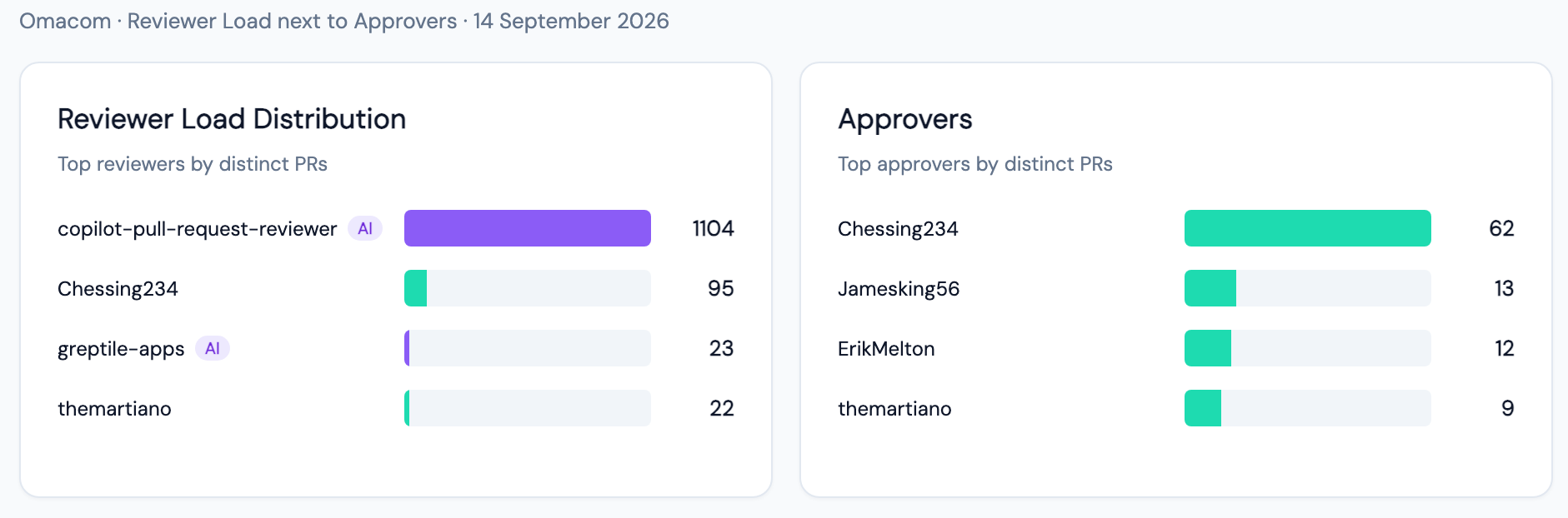
Omacom is the gap the changelog is aimed at. Copilot did 1,104 of 1,710 reviews. Approvals are still people. None of the 151 recorded approvals is Copilot. They merge about 112 pull requests a week and open about 640. AI is already in the review seat. It is not in the approval seat. Turning the new setting on would change that.
OpenAI already merges at a 12-minute median, 686 a week. An AI reviewer leads the review list. Copilot is seventh. Approvals are people. Copilot-as-approver is not the obvious missing piece. The open question is closer to the earlier post: what a fast merge is made of.
Microcks has no AI on either list. One maintainer does most of the reviews and most of the approvals. This setting does not fix that load. It would add a new reviewer.
Microsoft is the large-throughput case with a different kind of automation. They merge about 6,199 pull requests a week. Copilot is third on reviews, at 11,812, and does not appear on approvals. Other automation already sits on that list, including the person-run pipeline we wrote about in The Pseudo-Bot Reviewer. They already have a way to keep a gate moving.
So the news is an option for teams that already produce a lot of code, often with AI, and still wait on a person to satisfy the merge rule. GitQuick's job is the two lists. If Copilot already reviews and already approves, you are deciding whether that should count. If Copilot already reviews and never approves, you are deciding whether AI approval is necessary. If AI is on neither list, this setting is a new process, not a missing piece of the current one.
Quality stays with you. GitQuick can tell you who is reviewing, who is approving, and whether AI is already in one of those seats.
The 37signals and Omacom dashboards are public. Look at Reviewer Load next to Approvers. Same check on your own org.
Disclaimer: Public GitHub metadata only, from one-month showcase windows completed 12 to 18 September 2026. Reviewer type is inferred from account login and can be wrong. Counts are activity, not review quality or product quality. GitQuick cannot see whether Copilot is configured to count toward required approvals. Not affiliated with GitHub or the organizations named.