Code Review Bottlenecks: Measure Reviewer Concentration
Measure reviewer concentration with top-one and top-two review share, find where pull requests depend on a few reviewers, and test a backup plan.
By Ahmad Hajjar
A team can have ten active reviewers and still depend on two of them to keep pull requests moving. Reviewer concentration measures how much recorded review activity goes through the same accounts. It gives engineering leads a place to look when code review seems fine on a normal day but stalls when a particular person is out.
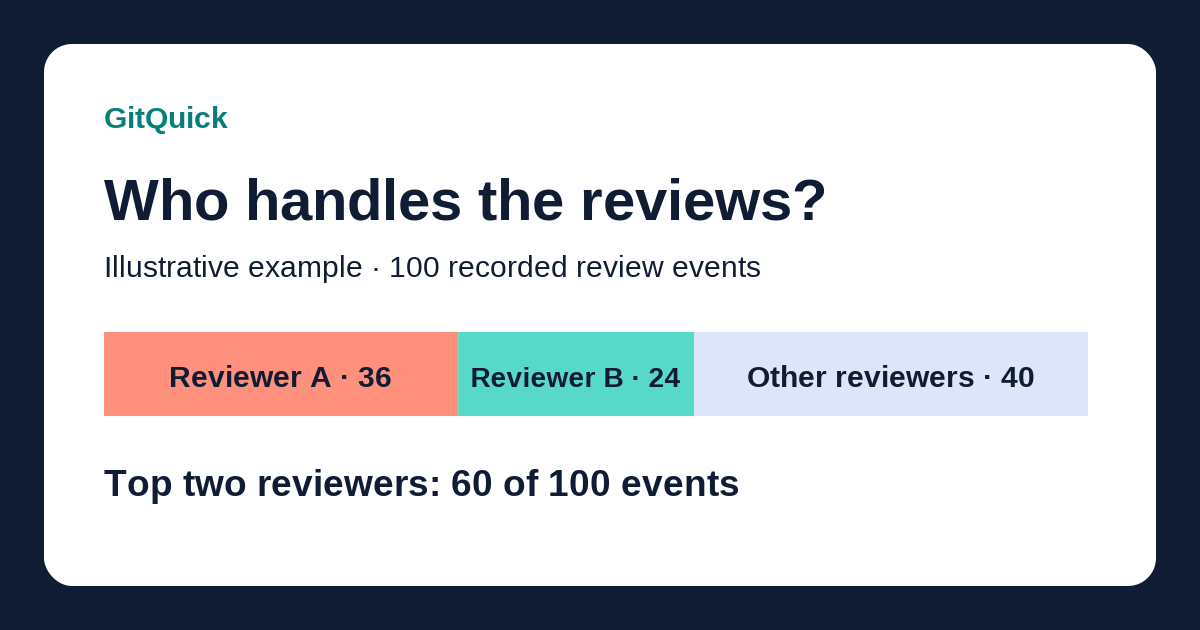
Illustrative example. The counts are hypothetical.
What reviewer concentration measures
Rank reviewer accounts by the number of review events they submitted in the same scope and period. Add the counts for the two highest-volume accounts and divide by all review events in the reviewer-load data. This is the top-two reviewer share. The top-one share uses only the highest-volume account.
Suppose the leading account submitted 36 reviews and the second submitted 24. The remaining accounts submitted 40 between them. The top-one share is 36% and the top-two share is 60%. Several submissions from one account on the same pull request can raise its share. An analysis that counts distinct pull requests per reviewer answers a different question.
Reviewers per pull request asks how many distinct accounts typically participate in a PR with recorded reviews. Concentration asks how work is distributed across reviewers in a scope. If every PR has two reviewers and the same pair always reviews it, participation is two and the top-two concentration is 100%. If different pairs take turns, participation can stay at two while concentration drops.
Distinguish expertise from a dependency
Concentration can be expected. A repository might have a small maintainer group, or two engineers may be qualified to review a particular subsystem. A large share becomes operationally relevant when work cannot move without the most active reviewers. Ask which PRs they work on, what decision requires them, and who can make that decision in their absence.
Start with one repository and a fixed period. Inspect several PRs reviewed by the top accounts and several that waited unusually long for their first review. Look for a pattern tied to a path, a repository rule, or an informal routing habit. Then compare that with a similar set of PRs that moved promptly. A shared reviewer across both groups can help you narrow the question, but you need the PR timelines to know when that person was requested and what else was pending.
Check the type of activity too. A review submission can be an approval, a request for changes, or a comment. A service account can submit frequent reviews. An account with many submissions may be doing repeated follow-ups, signing off on a protected path, or running automation. The event counts give no estimate of working hours.
Check routing and approval separately
GitHub's CODEOWNERS documentation explains how files map to owners and how protected branches can require their approval. A team request can distribute notifications, while required approval can still depend on a small group of qualified owners. Check both before changing assignment.
GitHub documents two team review assignment algorithms. Round robin favors people whose last request was least recent. Load balance also considers recent request totals and outstanding reviews. Either can distribute routine requests when team members have comparable expertise. Where the bottleneck is a protected path, train a second owner and check that they have the access and context to approve it.
Track the change for another comparable window. Compare top-one and top-two shares alongside the total recorded reviews and the number of reviewers. Check first-review median and P90 with their own eligible sample sizes. A lower concentration with a growing wait in the slowest PRs is a reason to inspect routing again. A stable concentration with fewer PRs blocked on an absent owner may still be progress.
Use GitQuick’s reviewer concentration signal
GitQuick calculates the share from reviewer-load rows within the analysis scope. Its default top-one threshold is 35% and its top-two threshold is 50%, both inclusive. The signal also checks for fewer than three reviewers once at least 20 reviews are recorded. These rules help prioritize investigations. Start with the reviewer-load distribution, then open the underlying GitHub PRs to check the policy and sequence behind the numbers.
Pick one frequently reviewed path. Write down who can review and approve it today, who can serve as backup, and which requests the backup will handle over the next month. The follow-up question is concrete: when the usual reviewer was unavailable, could someone else make the decision?
Read the GitQuick signals guide, explore a public showcase, or try GitQuick on your organization.
Disclaimer: GitQuick measures recorded GitHub workflow activity. Review-event share cannot establish individual effort, availability, review quality, or why a particular pull request waited.