Wait for the Approval, the Check, or the First Review
GitHub CLI 2.105.0 waits for one pull request event. On public organizations this month, the slow stage is a review, an approval, or a check.
By Ahmad Hajjar
On November 18, 2026, GitHub CLI 2.105.0 added gh event listen. An agent can wait on one pull request until a review is submitted, the head changes, a merge conflict appears, a check suite completes, or the pull request changes state. The command exits after the first matching event. On Vercel, that first event is the wrong place to stop.
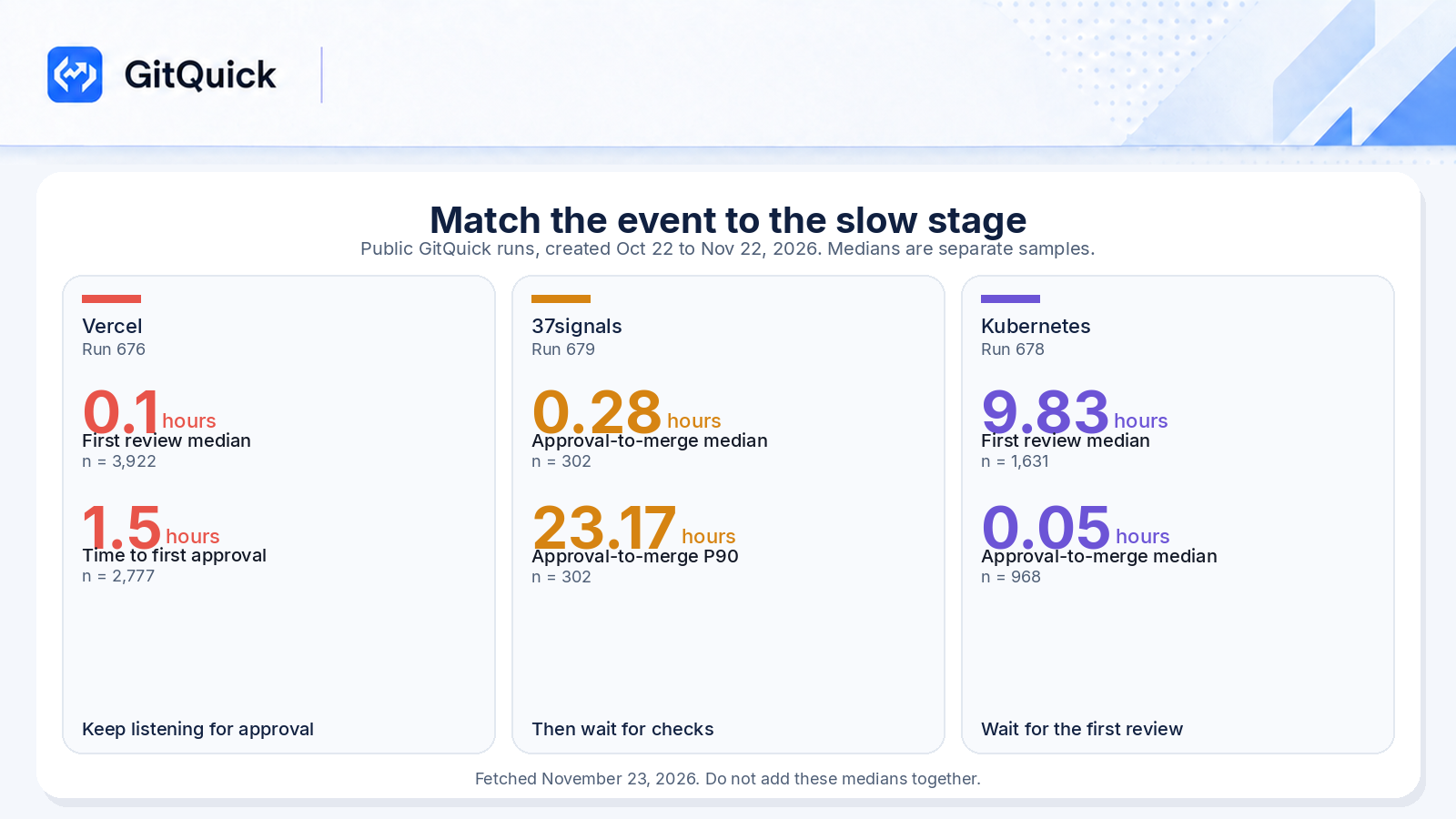
GitQuick's public showcase, fetched November 23, 2026, lists 22 rows for 21 organizations. Vercel run 676 covers pull requests created from October 22 to November 22. The median wait for a first review was 0.1 hours, on 3,922 pull requests. The median wait from open to a first approval was 1.5 hours, on 2,777 pull requests. Bot reviews were 181 of 12,814 events, 1.41%, and all 181 were logins classified as AI review tools. A six-minute first review, in a queue where almost every review event is from a person, still leaves the approval an hour and a half out at the median.
The event names a change, not a decision
GitHub's Event Streams documentation says: "Events currently tell you that something changed, not what changed." A review event does not include the review's state. A state-change event does not say whether the pull request was merged, closed, marked ready for review, or converted to a draft. Each review comment, and each reply to a review comment, is its own review event. The agent has to fetch the API URL in the payload before it treats the wake-up as progress.
Check-suite events include a conclusion, such as success or failure, and a pull request usually has one suite per app. There is no event for "all checks completed," and the conclusion does not say whether the suite was required. On November 19, GitHub changed the new pull request Overview so that failed optional checks no longer make a mergeable pull request appear blocked. The event stream was not given that filter. An agent that stops on every failure will still stop on an optional suite.
Read three clocks before you subscribe
Time to first review runs from creation to the first submitted review by any account. Time to approval runs from creation to the first APPROVED review. Approval-to-merge runs from the last approval to the merge, and only merged pull requests with a non-negative interval are included. Drafts stay in the created set. These are different sets of pull requests. The hours below are not pieces of one timeline, and they should not be added or subtracted.
The rows are examples, not a ranking. Each window is that run's own month. All three fall on October 22 to November 22, 2026, with different start times.
| Vercel, run 676 | 37signals, run 679 | Kubernetes, run 678 | |
|---|---|---|---|
| Created | 5,865 | 807 | 3,168 |
| Merged | 3,097 | 456 | 1,938 |
| First review | 0.1h median, 24.99h P90, n=3,922 | 0.03h, 0.09h, n=773 | 9.83h, 134.7h, n=1,631 |
| Time to approval | 1.5h, 71.2h, n=2,777 | 0.03h, 3.71h, n=456 | 13.37h, 163.92h, n=1,013 |
| Approval to merge | 0.21h, 12.07h, n=2,497 | 0.28h, 23.17h, n=302 | 0.05h, 2.29h, n=968 |
| Bot reviews | 181 of 12,814 (1.41%) | 1,402 of 2,620 (53.51%) | 156 of 4,442 (3.51%) |
| Merged without approval | 590 of 3,097 (19.05%) | 149 of 456 (32.68%) | 963 of 1,938 (49.69%) |
AI reviews are a subset of bot reviews. On Vercel and Kubernetes, every bot review in these runs was in that subset. On 37signals, 1,354 of 2,620 reviews were classified as AI, 96.6% of the bot reviews. Merged without approval includes merges that had no review at all.
Pick the listener from the slow stage
On Vercel, keep the review subscription open. Fetch each review. If the state is COMMENTED or CHANGES_REQUESTED, wait for another review event. Stop that wait when the fetched state is APPROVED, or when a state-change event and a fetch show that the pull request merged or closed. The second path matters: 590 of 3,097 merges had no approval. Among merged pull requests that did receive a review, 2,507 of 2,709 were approved, so an approval is how most reviewed merges finish. It is not how the first event looks. The time-to-approval P90 is 71.2 hours, so the same listener also covers a long tail, not only the 1.5-hour median.
On 37signals, the medians for first review and time to approval are both 0.03 hours, about two minutes. The tails are not. First-review P90 is 0.09 hours, on 773 pull requests. Time-to-approval P90 is 3.71 hours, on 456. After the last approval, the median wait to merge is 0.28 hours and the P90 is 23.17 hours, on 302 merged pull requests. The typical approved pull request merges in well under an hour. About one in ten of that sample waits close to a day. Once a fetch shows APPROVED, listen for check-suite and merge-conflict events, then read the pull request checks before treating a failure as a block. Also listen for state changes. 149 of 456 merges had no approval, while only 11 had no review at all.
On Kubernetes, the long clock is the first review: 9.83 hours at the median and 134.7 hours at the P90, on 1,631 pull requests, with bot reviews at 3.51% of events. Approval-to-merge is 0.05 hours at the median and 2.29 hours at the P90, on 968 pull requests, so checks are not the stage holding completed work. Subscribe to review submitted, and pair it with state changed. Of 1,938 merges, 963 had no approval, and that count includes 614 merges with no review. An agent that proceeds only on APPROVED will not see how half of the merged work finished.
One command, then a fetch
This is the documented shape for the Vercel case. Replace the pull request URL. The command is in public preview, and the account has to be on the Event Streams waitlist.
gh event listen \
  --resource https://github.com/OWNER/REPO/pull/NUMBER \
  --event com.github.pull_request.review.submitted.v1,com.github.pull_request.state.changed.v1 \
  --follow \
  --timeout 30m
For the 37signals tail, add com.github.pull_request.check_suite.status.changed.v1 and com.github.pull_request.merge_conflict.v1. --jq .data.conclusion prints a suite's conclusion. It does not print whether that suite was required. GitHub only reports a merge conflict after someone views the pull request, so that event can arrive later than the others.
The stream does not replay. The CLI prints Listening for events. when it is open, and anything before that line is missed, including a gap while it reconnects, so read the pull request once that line appears. --timeout exits with status 8 when it fires first. A subscription is one pull request, it expires after 24 hours, and a token can hold 100. Events are for github.com, not GitHub Enterprise Server or GHE.com. Conversation comments do not emit events yet. Commit statuses created through the REST API are not check-suite events.
The command also does not choose which pull request to open. On 37signals, 269 pull requests were still open. The idle median was 288.09 hours, and 238 of the 269, 88.5%, had been idle at least 72 hours. Idle starts at the latest submitted review, including a bot review, or at creation if there has been none. A later commit or a conversation comment does not reset it. The November 19 Overview is where you see, on one pull request, whether a requirement is actually blocking.
What the next run can show
GitQuick does not count agent wake-ups, optional checks, or Event Streams subscriptions. It does show the three durations above, each with its median, P90, and sample size, on a public showcase and on an organization run.
On a later run with a similar set of repositories, compare the stage you tried to shorten. For Vercel, that is time to approval. For the 37signals tail, it is approval-to-merge P90, beside its sample. For Kubernetes, it is the first-review median and P90. Leave the other clocks next to it. A first-review median that stays at a few minutes while time to approval stays long means the listener should still be fetching the review state.
For one open pull request at a time, see Idle Pull Requests: Find the Right Blocker With GitHub's New Overview. For the wait after the last approval, see Your PRs Are Approved. Why Aren't They Merging?.
The dashboards below are public and require no GitHub installation:
See which pull request stage is slow →
Disclaimer: This analysis uses public GitHub metadata and GitHub's November 18 and November 19, 2026 documentation. Reviewer classification is based on account login heuristics and can misclassify accounts that do not follow common naming patterns. Review counts measure review activity, not review quality. Stage medians come from different sets of pull requests and are not a forecast. GitQuick is not affiliated with or endorsed by GitHub, Vercel, 37signals, Kubernetes, or any organization mentioned. Windows: Vercel run 676, 2026-10-22T03:00:26.043Z to 2026-11-22T03:00:26.043Z. 37signals run 679, 2026-10-22T20:01:02.227Z to 2026-11-22T20:01:02.227Z. Kubernetes run 678, 2026-10-22T05:00:33.611Z to 2026-11-22T05:00:33.611Z. Fetched November 23, 2026.