AI Code Review Did Not Make the Queue Easier
A November 13 survey of 2,590 developers found no link between using AI for review and less difficulty keeping up. On public GitHub organizations this month, a first review in minutes still sits next to an open queue that is mostly idle.
By Ahmad Hajjar
On November 13, 2026, Kaia Newman, Christian Bird, Jenna Butler, and Emerson Murphy-Hill posted a preprint on how developers are adapting code review. They interviewed 24 developers with heavy review loads and surveyed 2,590 developers at one large company. Responses were collected from July 29 through August 21, 2026. Using AI for review was common. It was not associated with an easier queue.
Of the 2,590 respondents, 82% had personally used AI for review, and 93% had seen an AI review bot on a pull request they review. None of the authors' measures of AI review use was correlated with less difficulty keeping up with volume. Personally using AI for review was correlated with more current difficulty (p = .006, r = .16). The authors read that as a heavy queue pushing people toward the tool. The correlation does not show which way the cause runs.
Reviewers still thought AI had helped the pull request in front of them: 78% said their review quality was better and 4% said worse, and 68% said their review was faster and 11% said slower. A person can move faster on one change while the queue stays hard. In the survey, 3.4 times as many respondents agreed as disagreed that keeping up had been difficult, and 56% said that difficulty had worsened, against 22% who said it had eased.
The practice the authors call highest ranked was a review by the author before a human is asked. On the non-AI list, 41% of 646 respondents had seen that expectation, and 27% of 635 placed it in their top two. Giving the reviewer the author's intent was next: 36% had seen it, and 26% placed it in their top two. Assigning more people or hours was more common than it was favored: 31% had seen it, and 11% placed it in their top two.
Interviewee P16 said, "you must carefully review your own code before you're asking my time to review the code the robot wrote." P9 named the missing signal: "this is ready to review for humans." The paper is a preprint from one company, and reported helpfulness is not a measured change in review time.
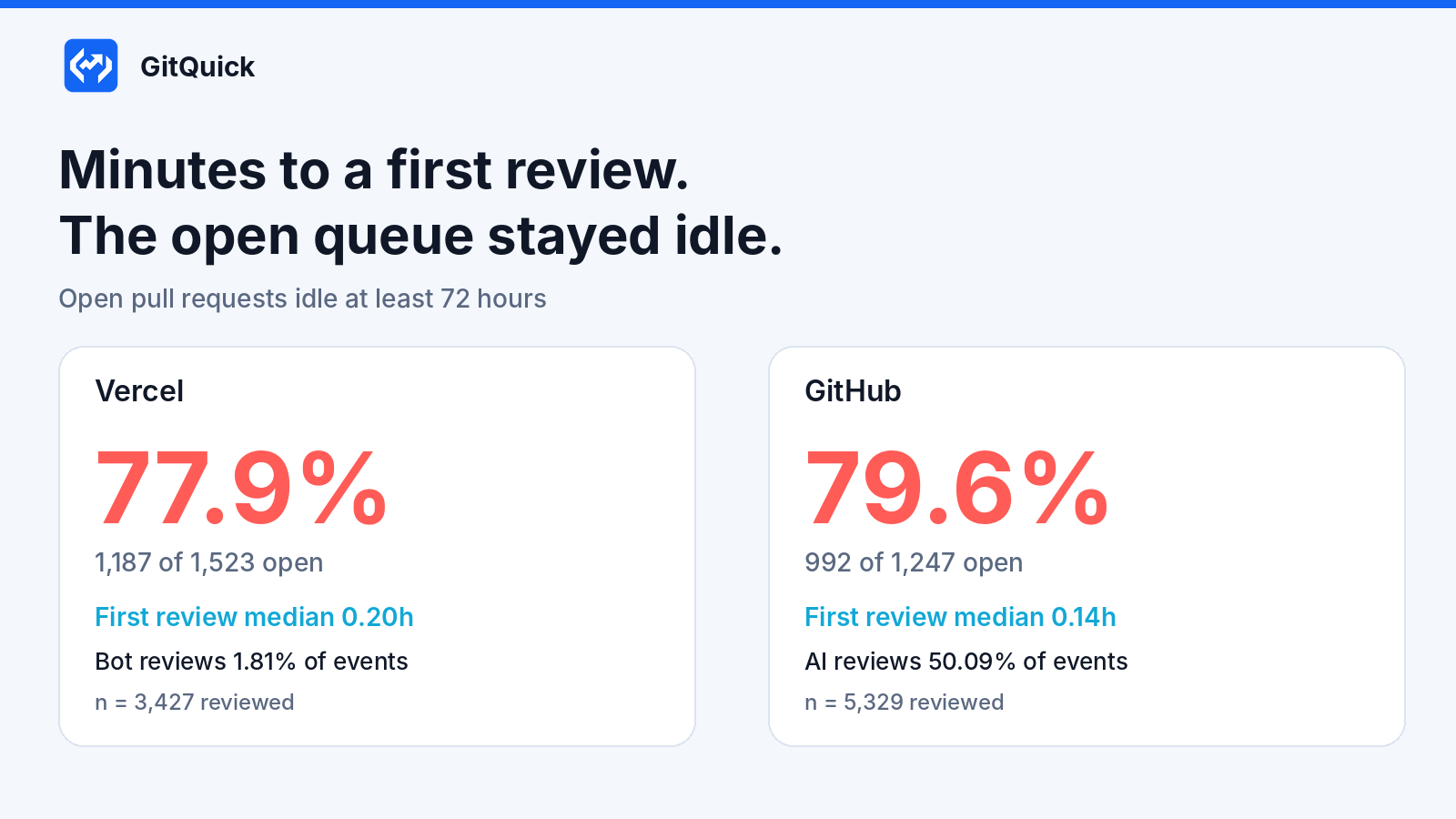
Reviewed work and the open queue
GitQuick's public showcase, fetched on November 21, 2026, shows the same split. Time to first review runs from creation to the first submitted review by any account, and only pull requests with that interval are counted. Idle time covers pull requests that are still open. It starts at the latest submitted review, or at creation if there has been none. A bot review resets that clock. A commit or an ordinary comment does not.
| Vercel, run 652 | GitHub, run 674 | |
|---|---|---|
| Window | Oct 15 to Nov 15 | Oct 21 to Nov 21 |
| Created in the window | 5,351 | 6,397 |
| First review | 0.20h, 52.72h, n=3,427 | 0.14h, 3.78h, n=5,329 |
| Bot reviews | 193 of 10,655 (1.81%) | 10,911 of 16,589 (65.77%) |
| AI reviews | 191 of 10,655 (1.79%) | 8,310 of 16,589 (50.09%) |
| Open pull requests | 1,523 | 1,247 |
| Idle at least 72h | 1,187 (77.9%) | 992 (79.6%) |
| Idle median | 236.81h | 224.72h |
| Opened / merged per week | 891.83 / 467.17, 6 weeks | 1,279.4 / 810.8, 5 weeks |
| Total lines | 159 median, 1,723 P90, n=5,351 | 58 median, 1,469 P90, n=6,397 |
The windows end six days apart. AI reviews are logins GitQuick classifies as known AI review tools, and those logins are already inside the bot count. On GitHub, the 8,310 AI reviews are 76.2% of the 10,911 bot reviews.
Vercel's first-review median is 0.20 hours, 12 minutes, with bot reviews at 1.81% of events. The P90 is 52.72 hours: the middle of reviewed work is fast, and a minority waits about two days. GitHub's median is 0.14 hours, about 8 minutes, the P90 is 3.78 hours, and AI reviews are half of events. The open queues do not follow that difference. In both organizations, about four in five open pull requests have gone at least 72 hours since the latest submitted review, or since creation. The idle medians, 236.81 hours and 224.72 hours, are a little over nine days.
Kubernetes, run 654, October 15 to November 15, is the slow shape. First review is 8.82 hours at the median and 119.18 hours at the P90, on 1,699 pull requests. AI reviews are 153 of 4,719 events. Of 985 open pull requests, 829 (84.2%) were idle at least 72 hours, and the idle median is 279.69 hours. A slow first review and a fast one can leave a similar open queue.
What to change first
Compare those two clocks on one recent month of your own organization before you add a reviewer or raise an AI review setting.
If the first-review median is already short and most open pull requests are idle for 72 hours or more, the work that received a review was picked up. The open set was not. Ask the author to read the diff, including an AI pass the author owns, before requesting a person. Keep the pull request in draft until that pass is done and the author's checks are green. In the survey, a readiness rule before human review had been seen by 41% of 646 respondents, and 15% of 635 placed it in their top two.
If total lines at the P90 are many times the median, the strain is a minority of large changes. GitHub's median is 58 lines and the P90 is 1,469, on 6,397 created pull requests. Vercel's median is 159 and the P90 is 1,723, on 5,351. The survey's most common challenge was this one: 47% said a changeset was too large at least half the time, and 60% said that had become more common, against 13% who said less. Split or hold the tail. A size block was less favored than self-review: 18% had seen one, and 11% placed it in their top two.
If opened per week stays well above merged per week, the organization is creating more pull requests than it merges. Do not subtract the rates. A pull request created this week can merge later, and a merge this week can have been created earlier. Drafts stay in the created set, because the metrics query does not drop them. GitHub averaged 1,279.4 opened and 810.8 merged across 5 active weeks, from 6,397 created and 4,054 merged. Vercel averaged 891.83 and 467.17 across 6 weeks, from 5,351 created and 2,803 merged.
Put the intent of the change in the description. That was the second practice on the top-two list, and it matches a shift 71% of 322 comparison respondents reported, against 14% who disagreed: their review had moved toward design and intent.
On a later run with a similar set of repositories, the idle share and idle median should fall if open work is actually being reviewed. Total-lines P90 should fall if large changes are split first. Opened per week and merged per week should move closer if the change is about finishing, and they still should not be subtracted. A slower time to first review can be the draft rule working, because that clock starts at creation. It is not, by itself, evidence that human reviewers got slower.
GitQuick shows the set on a public showcase and on an organization run: first-review median and P90 with the sample, AI reviews inside bot reviews, pull request size, weekly opened and merged counts, and the idle distribution. Trend is the later window.
A separate study found that coding agents lengthened both the wait for a person and the review after that comment: Coding Agents Slowed the Wait for a Reviewer and the Review Itself. For an idle pull request one at a time, see Idle Pull Requests: Find the Right Blocker With GitHub's New Overview.
The dashboards below are public and require no GitHub installation:
See your first-review time next to the idle open queue →
Disclaimer: This analysis uses public GitHub metadata and the named preprint. Reviewer classification is based on account login heuristics and can misclassify accounts that do not follow common naming patterns. Review counts measure review activity, not review quality. The survey describes one company and does not measure the public organizations. GitQuick is not affiliated with or endorsed by GitHub, Vercel, Kubernetes, Microsoft, Carnegie Mellon, or any organization mentioned. Windows: Vercel and Kubernetes, October 15 to November 15, 2026. GitHub, October 21 to November 21, 2026. Fetched November 21, 2026.