Coding Agents Slowed the Wait for a Reviewer and the Review Itself
On November 14, 2026, a Harvard paper found coding agents lengthened both the wait for a first human comment and the time after that comment. Public GitHub organizations this month show why a fast first review is not the open queue.
By Ahmad Hajjar
On November 14, 2026, Fiona Chen and James Stratton posted the current version of their Harvard job-market paper, Artificial Intelligence in the Firm: Bottlenecks in Software Production. After firms adopted coding agents, the average time from pull request submission to merge rose by 1.99 days, 56.1% of a 3.56-day baseline.
That extra time was not one wait. On pull requests that received at least one comment, the wait until the first comment from a human other than the author rose by 1.67 days, 59.9% of a 2.78-day baseline. The time from that comment until merge rose by 2.33 days, 58.5% of a 3.98-day baseline. Coding assistants had no significant effect on review length. Agents did.
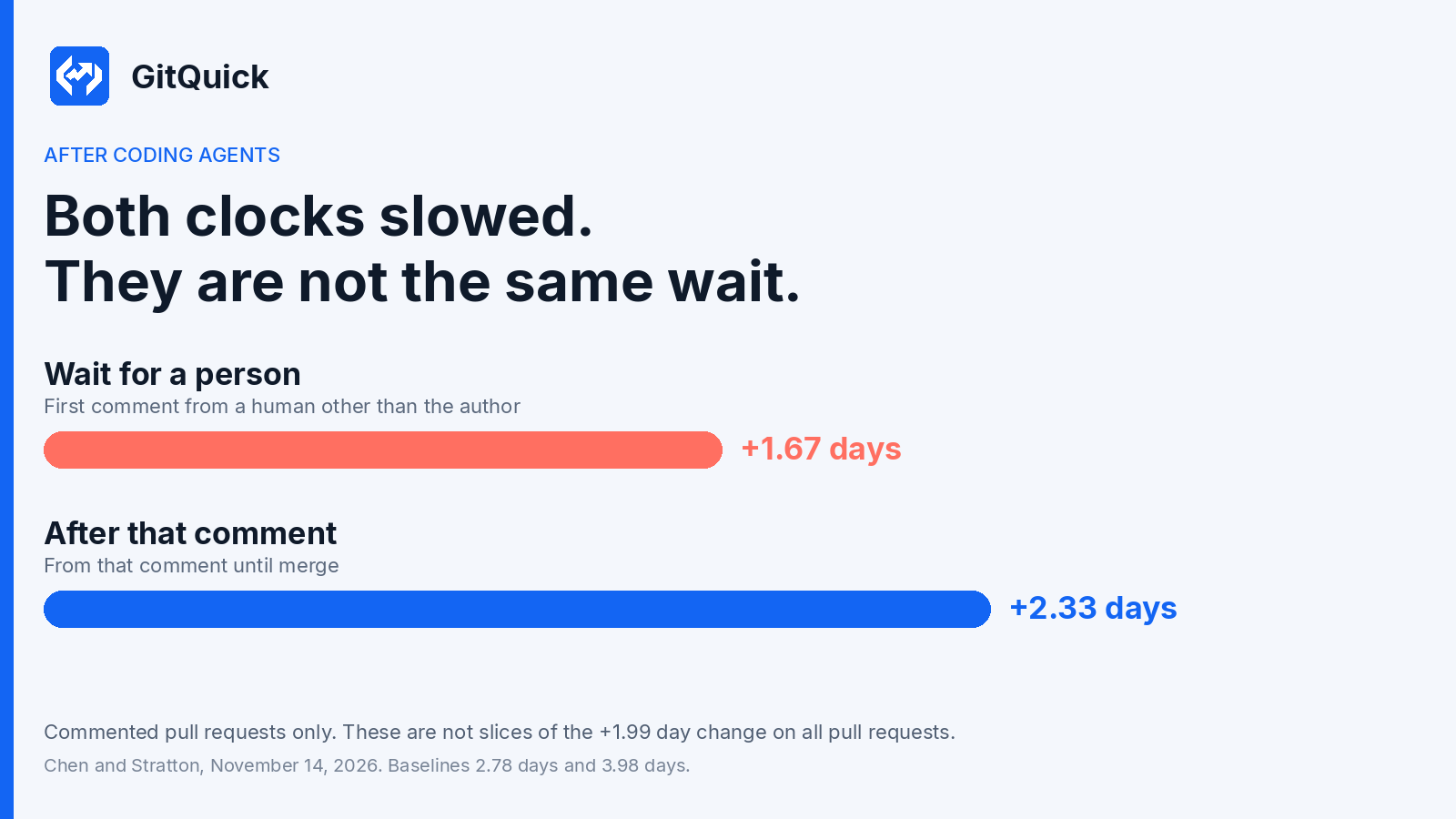
Added days after coding-agent adoption, on pull requests with at least one comment. These changes are not slices of the 1.99-day increase, which covers all pull requests.
Two clocks, two decisions
1.67 plus 2.33 is 4.00, not 1.99. The 1.99-day figure is the change from submission to merge across pull requests generally. The other two use only pull requests with at least one comment, which is the subset where those clocks can be split. The paper's introduction summarizes the 56.1% as time to approval. Figure 7 and section 5.2 measure days from submission to merge, and that is the figure used here.
Lines added per pull request did not change significantly, for assistants or for agents. Review comments per pull request did: up 0.629, 38.6% of a 1.63 baseline. The share of pull requests that received a comment, and the share blocked with a formal change request, moved the same way, but the paper calls those two estimates marginally insignificant. The heavier review is more comments on a change of similar size.
Who can pick the work up is narrower than a headcount. In the same data, 82.8% of reviews were in a codebase where the reviewer had already committed code or opened a pull request. Random assignment inside the firm and month would have put that share at 17.2%. By July 2026, 79.1% of the firms had used AI tools in code review, yet only 23.3% of review comments were generated by AI, and only 10.8% of pull requests received an AI comment.
The extra 1.67 days is a pickup problem for someone who already knows the code. The extra 2.33 days is the review itself. Smaller changes, a clearer owner, or a look at what the comments keep asking for belong to the second clock. Another review bot does not, by itself, move either one. The estimates cover 720,542 workers at 655 firms, from January 2021 through August 2026, in Jellyfish data. This is a working paper, not a journal article, and it is an average adoption effect.
A nine-minute first review is a different clock
GitQuick's time to first review runs from open until the first submitted review from any account, human or bot, and only when that interval is zero or positive. That is not the paper's wait for a human comment. The public organizations below are not the 655 firms, and the windows are not a before-and-after of agent adoption. They were fetched on November 19, 2026. Each timing cell is the median, the P90, and the sample.
| Anthropic, run 664 | Apple, run 663 | Google Cloud, run 671 | |
|---|---|---|---|
| Window | Oct 18 to Nov 18 | Oct 18 to Nov 18 | Oct 19 to Nov 19 |
| Pull requests opened | 2,420 | 1,434 | 9,577 |
| First review | 18.64h, 234.23h, n=688 | 4.14h, 94.39h, n=1,043 | 0.15h, 49.81h, n=5,628 |
| First approval | 23.45h, 273.2h, n=562 | 7.75h, 125.29h, n=978 | 11.45h, 141.29h, n=3,493 |
| Approval to merge | 0.00h, 1.03h, n=522 | 0.52h, 24.48h, n=876 | 0.36h, 11.97h, n=3,305 |
| Open to merge | 26.19h, 276.6h, n=526 | 16.94h, 161.08h, n=951 | 5.48h, 119.76h, n=5,814 |
| AI reviews / all reviews | 65 / 1,112 | 0 / 2,570 | 2,744 / 13,016 |
| Open pull requests, idle median | 1,423, 475.98h | 414, 136.91h | 2,346, 180.96h |
Anthropic and Apple end one hour apart. Google Cloud ends a day later. The rows are examples, not a ranking. First approval runs from open to the first approving review. Approval to merge runs from the last approval to merge. Idle time covers currently open pull requests and starts at the last human review, or at open if there has been none. Commits and comments do not reset it.
Anthropic's first-review median is 18.64 hours, and all 65 bot reviews were classified as AI, out of 1,112. A bot did not set that median. Approval to merge is 0.00 hours at the median and 1.03 hours at the P90. Merging was not the wait on the 522 pull requests that reached approval. The 26.19-hour merge median describes 526 merged pull requests. It does not describe the 1,423 still open, whose median idle time is 475.98 hours.
Apple recorded no bot reviews and no AI reviews in 2,570 reviews. First review is 4.14 hours at the median and 94.39 hours at the P90. A human-only clock can look moderate in the middle and still leave a multi-day tail. Approval to merge is 0.52 hours at the median and 24.48 hours at the P90: most approved work merged in about half an hour, and a minority waited about a day.
Google Cloud's first-review median is 0.15 hours, 9 minutes, on 5,628 pull requests. AI reviews were 2,744 of 13,016 events, inside 3,486 bot reviews. Nine minutes is not evidence that a person picked the work up. First approval is 11.45 hours on a different sample of 3,493, so that gap is not "11.3 hours of active review." Approval to merge is 0.36 hours at the median. The open-to-merge median, 5.48 hours, is shorter than the approval median because the samples differ, and medians from different sets do not subtract. The 2,346 pull requests still open have a median idle time of 180.96 hours, about 7.5 days.
What to write down before you change the queue
Use one window, and record four readings with their samples: time to first review beside the AI and bot counts, time to first approval, approval to merge, and the open-queue idle median.
A first-review median of a few minutes, next to a large AI share, is not the paper's wait for a person. Read approval and the open queue before you decide pickup is fine. A long first review with few bot reviews, and a short approval-to-merge, as at Anthropic, points at getting a human to the pull request, not at the merge button. A short approval-to-merge median with a long P90, as at Apple, is a tail: checks, queue, or ownership for that minority. An idle median measured in days, beside a merge median measured in hours, means the completed pull requests are not the work still waiting.
Then open the idle list. Separate pull requests with no human review from pull requests whose only review was a bot. Re-measure the same four readings on a later window of similar length. A faster first review that comes entirely from a new bot, with idle time and time to approval unchanged, did not shorten the wait the paper describes.
GitQuick shows those four readings, with median, P90, and sample, for a connected organization and for the public ones above. AI reviews are a subset of bot reviews, classified from account logins. GitQuick does not know which teams adopted coding agents, and it does not reconstruct the paper's first-human-comment split.
The pipeline breakdown is why stage medians from different samples do not add. Idle pull requests covers the open-queue distribution in more detail.
The dashboards below are public and require no GitHub installation:
See which review clock is long →
Disclaimer: This analysis uses public GitHub metadata and Fiona Chen and James Stratton's working paper, Artificial Intelligence in the Firm: Bottlenecks in Software Production, current version November 14, 2026 (https://fion.ac/jellyfish.pdf). The paper is not a journal article. Its estimates use Jellyfish data for 655 firms from January 2021 through August 2026 and are average adoption effects, not a prediction for any one team. Showcase figures were fetched on November 19, 2026. Anthropic run 664 covers October 18, 2026 at 04:00 UTC to November 18, 2026 at 04:00 UTC. Apple run 663 covers October 18, 2026 at 03:01 UTC to November 18, 2026 at 03:01 UTC. Google Cloud run 671 covers October 19, 2026 at 05:01 UTC to November 19, 2026 at 05:01 UTC. Reviewer classification uses account login heuristics and can misclassify accounts that do not follow common naming patterns. Review counts measure review activity, not review quality. Time to first review includes bot reviews. Idle time is the wait since the last human review, or since open when there is none. Stage medians come from different pull request samples and should not be added or subtracted. GitQuick is not affiliated with or endorsed by GitHub, Jellyfish, or any organization mentioned.