Code Review Metrics by Programming Language: Compare Workflows Fairly
Compare code review metrics by programming language without confusing repository labels, review samples, and workflow differences with language performance.
By Ahmad Hajjar
Code review metrics grouped by programming language describe the repositories in each group. They do not establish that one language causes faster reviews.
That distinction matters when a dashboard puts Java, TypeScript, and Python in adjacent rows. The rows look comparable. The work behind them may involve different maintainers, approval rules, release schedules, and kinds of changes.
Use the comparison to find a review process worth investigating. Before changing a policy, establish what the language label actually measures.
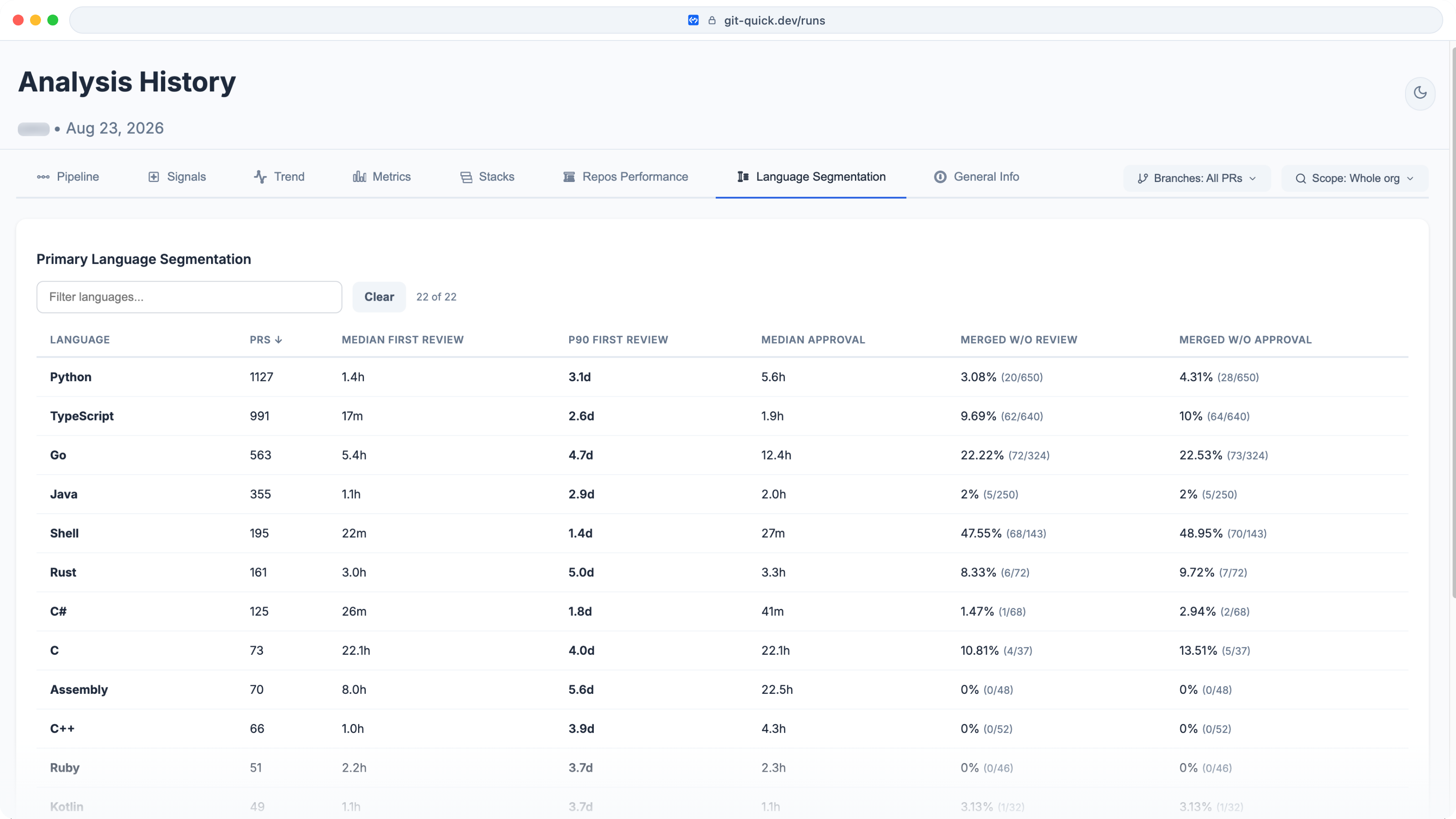
Historical product illustration: AWS analysis shown on August 23, 2026. The screenshot demonstrates the interface. Its figures are not current October measurements, and its PR totals are not the eligible sample sizes for every latency column.
What a primary-language group contains
GitHub uses Linguist to identify repository languages. Its language statistics describe repository files and update after changes reach the default branch.
GitQuick's grouping uses the dominant language by bytes in that default branch. It assigns a pull request to its repository's primary-language group. It does not classify the files changed in that pull request.
A documentation update in a predominantly Java repository therefore belongs to the Java group. A Python service inside a TypeScript-dominant monorepo, meaning one repository containing several projects, also belongs to the TypeScript group.
Repositories without language metadata are excluded from the language aggregates. The underlying response reports coverage so that missing classification can be checked.
This makes the label useful for locating related repository workflows. It makes it unsuitable as a direct measurement of language-specific review difficulty.
Why the fastest row may answer the wrong question
Consider a hypothetical comparison between a Java backend and a TypeScript frontend. The backend requires a specialist approval for sensitive changes. The frontend receives many small dependency updates with automated reviews.
A lower first-review time in the TypeScript group could reflect immediate automation. A higher approval time in the Java group could reflect specialist availability. Neither result isolates the effect of the programming language.
The same problem appears within one organization. A busy repository can dominate a language group. Moving work into a monorepo can change its classification without changing the implementation language. A month with many routine updates can make the group look faster.
Treat each of these as a possible explanation to check, rather than an explanation the dashboard has already proved.
The useful management question is: Which workflow difference explains the gap, and is that difference intentional?
Read these measurements together
GitQuick's Primary Language Segmentation table presents PR counts, median and P90 first-review time, median approval time, and shares merged without review or approval. The underlying per-language response also supplies eligible latency sample sizes and classification coverage.
Those measurements answer different questions:
| Measurement | What it describes | Check before comparing |
|---|---|---|
| PR count | PRs created in the selected analysis window | Whether one repository or kind of work dominates |
| First-review latency | Creation to the first recorded submitted review | Eligible sample size and automated review activity |
| Approval latency | Creation to the first recorded approval | Its own eligible sample and approval requirements |
| P90 first-review latency | The value at or below which approximately 90% of eligible observations fall | The delayed PRs behind the tail |
| Merged without review | Merged PRs with no recorded review, divided by merged PRs in the selected cohort | Counts, denominator, and repository policy |
| Classification coverage | The share of window PRs with repository-language metadata | Whether missing metadata affects a meaningful part of the work |
A PR that has not received a review cannot contribute a completed first-review duration. Its absence from that latency sample does not mean its wait was short.
Likewise, the PR count displayed beside a language is not automatically the sample size behind its median. Record the eligible sample separately when sharing a comparison. Avoid precise claims when that sample is unavailable.
Review timestamps also measure elapsed time, including waiting. They do not measure how long someone actively read the code. A submitted review can come from automation, so fast first feedback does not establish fast human attention.
Compare similar work before choosing an action
Start with the same analysis window and write down the repository scope. Then inspect the work behind any apparent outlier.
Check change size and purpose. Separate routine dependency updates, generated changes, documentation, and feature work during investigation. Google's engineering guidance on small changes explains why focused changes are easier to review. It also distinguishes mechanical changes from changes that require substantial reasoning. Line count alone cannot make two groups equivalent.
Check review obligations. Find out whether one group requires a particular owner, several approvals, or renewed approval after updates. A deliberate control can increase waiting time. Removing it to improve a metric requires a separate risk decision.
Inspect repositories and delayed PRs. Determine whether the pattern appears across the language group or comes from one repository. Read a sample of the slow cases. Missing context, unclear ownership, and an unavailable specialist require different responses.
Check the work still waiting. Completed reviews describe observed responses. Include open work when deciding whether a workflow is healthy. Otherwise, the PRs that have received no attention remain absent from the timing comparison.
What the current public showcase can verify
On October 19, 2026, the live showcase list contained 21 organizations. Its language labels identify common repository languages; its headline measurements are organization totals.
The Microcks detail endpoint, checked the same day, describes a September 19 to October 19 snapshot. It supplies organization metrics but no per-language metric rows. Assigning its organization-wide review time to Java, C#, or TypeScript would therefore be unsupported.
No current language-speed ranking is presented here. The historical screenshot shows the available product surface, not fresh evidence of a difference between languages.
Make the comparison lead to a decision
A useful finding names the affected repositories, the comparable work, and the constraint to address. For example: specialist changes wait for one unavailable owner, so the team will train a backup and check the next comparable window.
That is more actionable than declaring a language slow. It also gives the team a hypothesis it can test without treating correlation as causation.
Related reading:
- Find code review bottlenecks before changing the whole organization
- Did your code review process actually improve?
Browse the public Microcks dashboard or all showcases.
Try GitQuick to inspect review latency and coverage by repository language →
Disclaimer: This article uses public GitHub metadata, current product implementation, and the primary documentation linked above. Language labels describe repository dominance, not individual PR contents. Public metadata cannot establish code quality, individual productivity, or causality. Reviewer classification uses login heuristics and may misclassify accounts. GitQuick is not affiliated with or endorsed by GitHub, Google, Microcks, or any organization mentioned.